WORKING PAPER · VERSION 0.3
One Theme, Four Portfolios
From monopoly-themed ETFs to the stocks behind their returns
Published by Monopoly MOAT at mplymoat.com. The author is affiliated with Monopoly MOAT, an independent research publication with no issuer compensation.
Working paper, version 0.3. This manuscript has not been peer reviewed. · Published 8 September 2026 · Returns through 4 September 2026 · 11 pages · 2 figures · 9 tables
ABSTRACT
One label does not produce one portfolio.
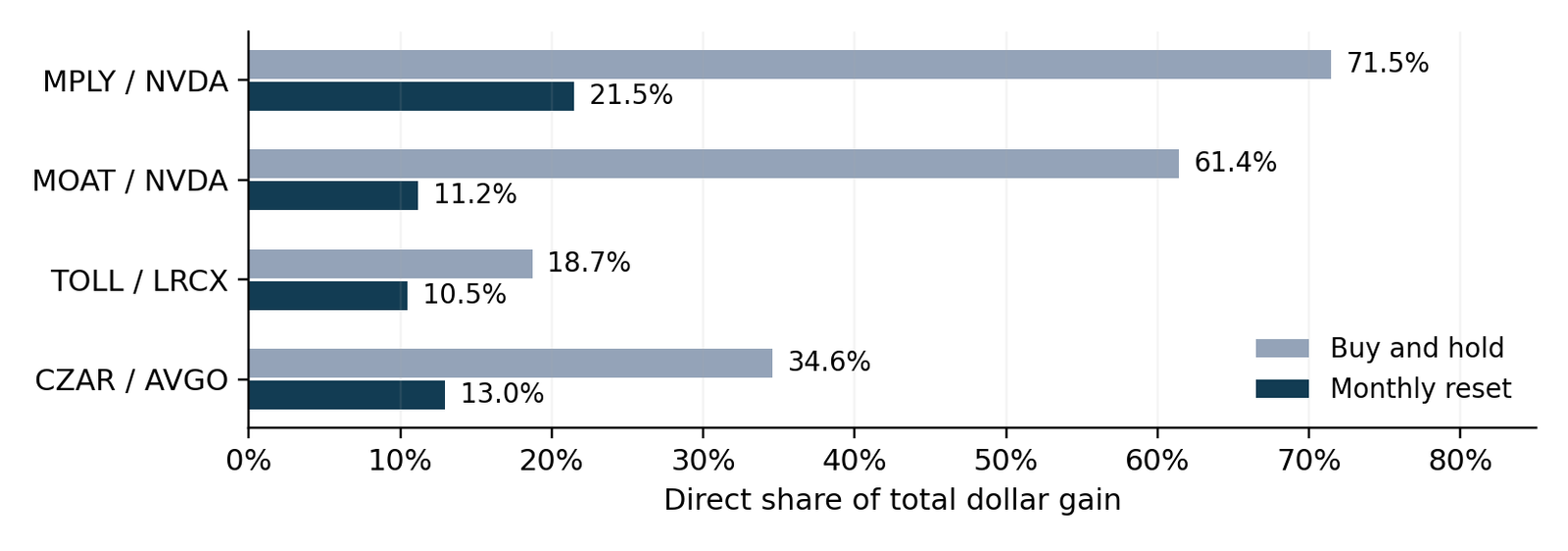
Monopoly power, economic moats, durable quality: four exchange-traded funds promise some version of the same idea. Do they deliver the same portfolio? We compare MPLY, MOAT, TOLL and the now-closed CZAR, first through their documented strategies and observed returns, then through a simulation of the stocks they recently held. The common live history is short, so we run a separate counterfactual from January 2016 to September 2026, asking how those holdings would have behaved under buy-and-hold and under monthly rebalancing. The results are less about the theme than about a few individual winners. Under buy-and-hold, Nvidia alone accounts for 71.5% of MPLY's total gain and 61.4% of MOAT's. One stock. Rebalancing monthly cuts those direct shares to 21.5% and 11.2%, and replacing each basket's largest contributor with cash still leaves annualized returns of 24.40%, 15.66%, 23.04% and 13.32%, respectively. The rankings themselves move with the starting date. None of this establishes a causal monopoly premium, and a replay of recent holdings cannot reconstruct what managers actually did. What it does show is more useful: one theme, four very different portfolios, with returns decided by the stocks behind the label.
THE ANALYTICAL JOURNEY
Follow the dominant stock through each test.
Buy-and-hold lets winners occupy more of the basket. Monthly rebalancing restores the frozen target weights. The last column reruns the monthly portfolio after replacing its largest full-period contributor with zero-interest cash from the beginning.
| Basket / largest contributor | Share of buy-and-hold gain | Direct share after monthly rebalancing | Remaining CAGR without contributor |
|---|---|---|---|
| MPLYNVDA | 71.5% | 21.5% | 24.40% |
| MOATNVDA | 61.4% | 11.2% | 15.66% |
| TOLLLRCX | 18.7% | 10.5% | 23.04% |
| CZARAVGO | 34.6% | 13.0% | 13.32% |
Gain share is a dollar-profit attribution, not a percentage of ending wealth. Remaining CAGR is recalculated from a different portfolio; it is not obtained by subtracting the gain share.
FINDINGS
The strongest result is the sequence, not the ranking.
From 16 May 2025 through 2 July 2026, all four ETFs finished below both SPY and ACWI in the market-price reconstruction.
Nvidia supplied 71.5% of MPLY's hypothetical buy-and-hold gain and ended at 70.1% of portfolio wealth.
Monthly rebalancing reduced Nvidia's direct MPLY gain share to 21.5% and its ending weight to 11.3%.
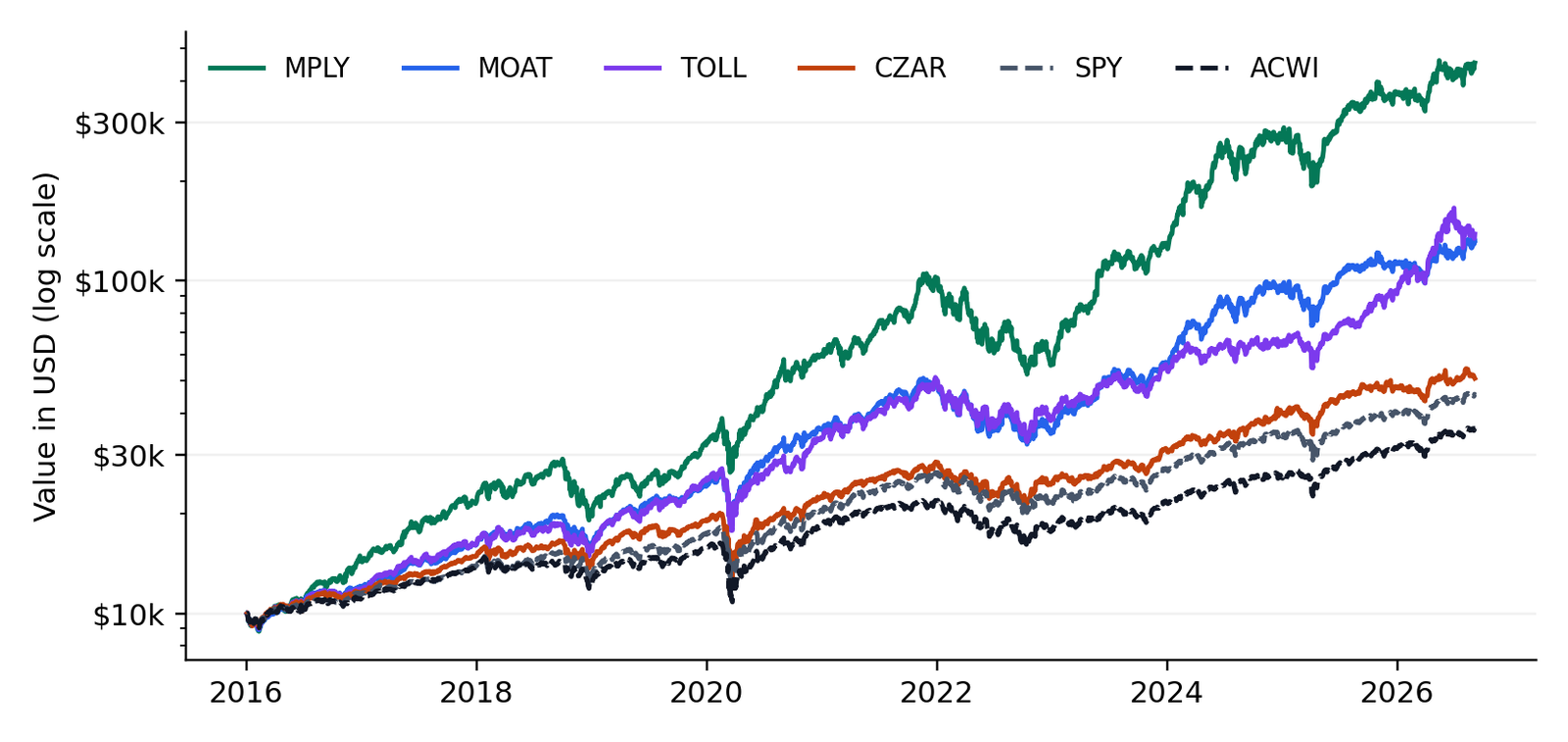
MPLY led the thematic baskets from 2016, 2018, and 2020; TOLL led from 2022 and 2024.
FIGURES
A high ending value can conceal a narrow source.
RESEARCH DESIGN
Observed fund returns and hypothetical holdings returns stay separate.
Live fund history
The common observed window begins with MPLY on 16 May 2025 and stops before CZAR's liquidation announcement. It describes investor experience in the ETFs themselves.
Holdings experiment
Recent holdings and weights are frozen, then replayed from 4 January 2016 through 4 September 2026. That is a hindsight-conditioned experiment, not a reconstructed ETF track record.
Monthly rebalancing
Each U.S. month-end resets the basket to its original target weights. The rule illustrates contained drift; it is not a claim about how the funds actually traded.
Robustness checks
Largest-contributor exclusions, five starting dates, and three trading-cost assumptions test specified alternatives. They do not make the exercise prospective or causal.
LIMITATIONS
The backtest knows which holdings survived.
The portfolios use later holdings to ask an earlier historical question. Their selected assets therefore contain survival and selection information that was unavailable in 2016. TOLL's private Kalshi exposure remains in zero-return cash; CZAR uses a June 30 pre-closure filing; five CZAR closes and its final liquidation payment remain unverified.
Provider-adjusted histories are not a complete independent reconstruction of every split, dividend, spin-off, and currency conversion. The paper reports targeted checks and preserves the remaining uncertainty. None of the results establishes a causal monopoly premium, persistent manager skill, or a forecast of future ETF performance.
PAPER AND RECORDS
The canonical page keeps the status visible.
A matching MPRA deposit (item 130838) was also placed in repository review. Neither repository screening nor journal submission is peer review or an editorial acceptance. The return inputs, derived paths, source receipts, and audit files remain preserved in the research project; credentials and restricted raw payloads are not published.
CITATION
Cite the canonical research page.
Mashhour, H. (2026). One Theme, Four Portfolios: From Monopoly-Themed ETFs to the Stocks Behind Their Returns. Monopoly MOAT. https://mplymoat.com/research/monopoly-etf-portfolios/
BibTeX
@misc{mashhour2026fourportfolios,
  author = {Hesham Mashhour},
  title = {One Theme, Four Portfolios: From Monopoly-Themed ETFs to the Stocks Behind Their Returns},
  year = {2026},
  publisher = {Monopoly MOAT},
  howpublished = {Working paper, version 0.3},
  url = {https://mplymoat.com/research/monopoly-etf-portfolios/}
}
DECLARATIONS
The boundaries are part of the result.
Affiliation: Monopoly MOAT (mplymoat.com).
Funding: This research was self-funded by the author and received no external funding.
Competing interests: The author reports no investments in MPLY, MOAT, TOLL, CZAR, or the individual stocks discussed, and no financial or professional relationships with the ETF issuers or managers.
AI assistance: The author directed the research design and interpretation and rewrote the manuscript. OpenAI Codex assisted with data retrieval, code, numerical calculations, consistency checks, and earlier drafts. The author reviewed the work and is responsible for its contents.
Research disclaimer: This working paper is informational research, not investment advice. The simulated portfolios use later holdings with hindsight and should not be read as achievable historical ETF returns or forecasts.